
I run sprint planning sessions for a living. Backlog refinement, story review, gap analysis — I do this at work without thinking about it. On my own project, I’d been skipping it. I was building alone. Who was I going to run a session with?
The answer, it turns out, was Claude.
We were reviewing user stories for the dashboard. The story said: show a 7-day grid of the current week with coverage status. A reasonable thing to have. I’d built it without questioning it.
Claude flagged it and asked whether the guardian should be able to navigate to other weeks too.
I stopped and typed:
“let’s review the objectives of the dashboard”
Claude asked:
“What do you want a guardian to walk away knowing after 10 seconds on the dashboard?”
I had an answer — I just hadn’t said it out loud yet. The dashboard was always meant to be more action-oriented. I’d just never thought to tell Claude that, because when you’re building alone, the things you know live in your head and stay there.
I asked what the dashboard currently showed. Claude went to the code: a 7-day grid hardcoded to the current week, a FK deadline countdown, a pending approvals count. No week navigation — for that you click through to the schedule.
Then I said:
“I think the dashboard should show who is working today, what do I need to do right now, and the upcoming reports that I need to fill up. Showing what’s coming for the week doesn’t seem to add so much value since that’s already covered in the schedule.”
Claude:
“The weekly grid is a calendar feature wearing a dashboard hat.”
Feature cut. One sentence. In a conventional sprint planning session, cutting a feature involves a discussion, a rationale, someone updating the backlog, a decision log entry. Here it was two lines of conversation and the story was rewritten.
This is what the dashboard looked like before:
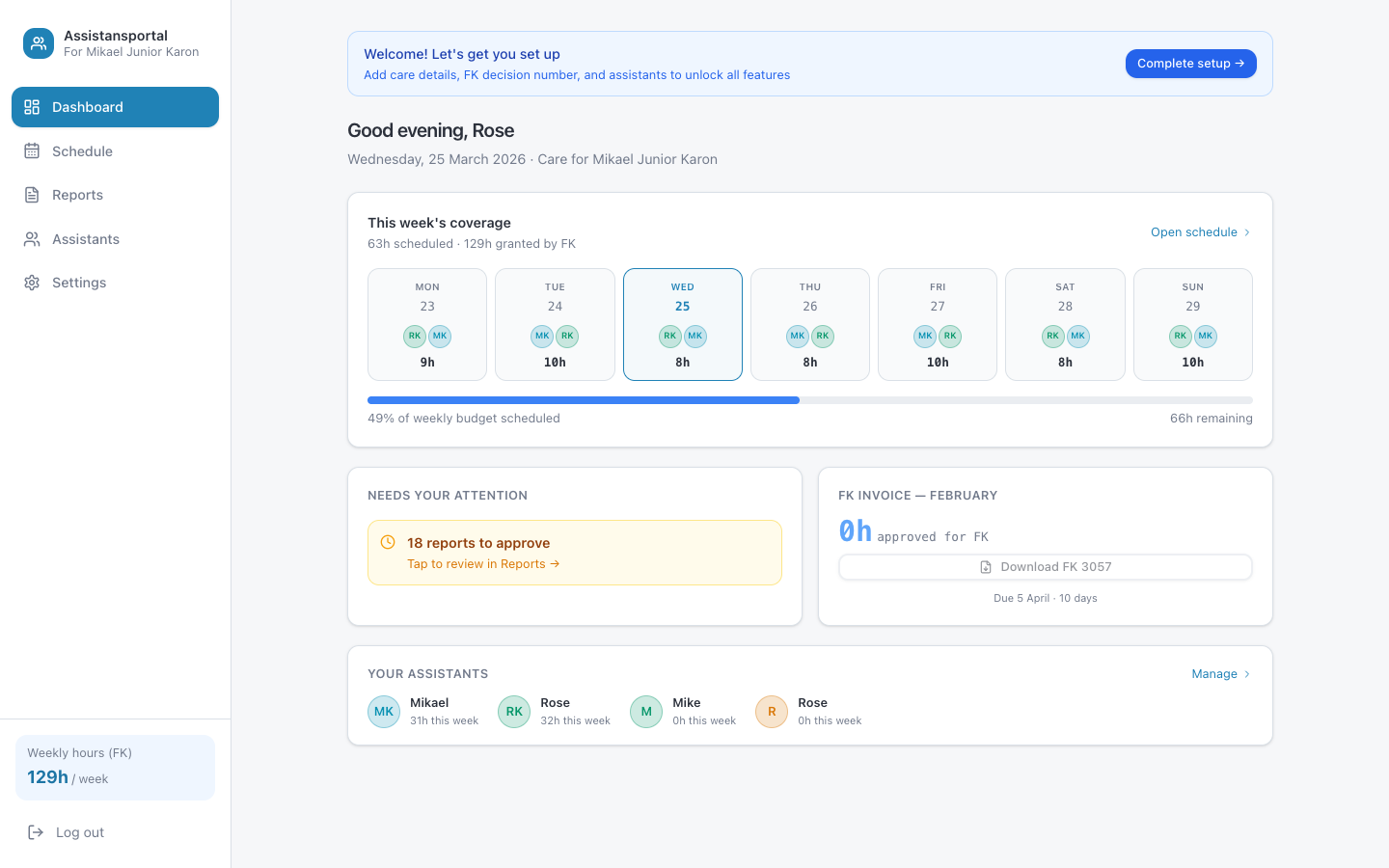 The current dashboard: a 7-day coverage grid, FK deadline countdown, and pending approvals.
And this is what it will look like after we make the changes:
 The proposed dashboard: who’s working today, what needs action, upcoming reports. [Coming soon]
Then I described how the monthly reports actually work.
Assistants log their shifts as they happen. The system aggregates those into a monthly report. The guardian reviews and approves it, generates a PDF, the assistant signs the printed copy, and it gets mailed by post to FK.
Claude:
“This changes US-09 and US-16. Both stories describe a guardian filling in daily hours — but that’s not what happens. The guardian’s job is to review what the assistant already logged. The stories were written for the wrong actor.”
They were. I’d written them early in the project when I was still working out how the workflow would go. The app had evolved. The stories hadn’t followed.
In a conventional team, someone would have caught this in refinement — a BA reading the story against the code, or a developer asking a clarifying question before picking it up. When you’re building alone, there’s no one to ask. The gap just sits there until it causes a problem.
Then Claude asked who does the actual shift logging — does the assistant have their own login?
“The assistants should have their own app where they can view their schedule, clock in and clock out.”
Claude:
“That’s a whole missing side of the product. The guardian can’t approve what was never logged. Is that v0.1 or v0.2?”
This was the biggest aha moment of the session.
The assistant app was always part of the plan. I just never wrote it down. When you’re building alone, unwritten scope doesn’t slow you down — you just don’t build it yet and move on. In a conventional project, this would have been a formal descoping decision. A story written, reviewed, and explicitly moved to the next release with a rationale. Here it existed only in my head, which meant it didn’t exist anywhere that mattered.
The session put it on paper for the first time.
Then came a question that sounds like something a PM asks a senior engineer on the first day of a sprint.
“could both these checks be applied as we log the schedule so it’s more proactive or would that be overkill for MVP”
This kind of question usually gets a long answer, a whiteboard, and a follow-up meeting. Claude:
“Not overkill — but the two layers need to do different jobs. A block on the schedule as you’re mid-entry is disruptive. A warning on the schedule tells you early, while you can still do something. The PDF block stays as a hard stop. Warn when there’s time to fix it. Block when it’s too late to ignore.”
Decision made. Two layers: amber warning on the schedule when an assistant is approaching their limit, hard block at PDF generation if the limit is actually breached.
What happened there isn’t just Claude answering a question. It’s Claude holding three things at once — the product goal, the implementation tradeoff, and the user experience — and coming back with a recommendation and a reason. That’s not a search or a task execution. That’s what a senior engineer does when they’ve thought about a problem for five minutes.
The difference is that you have to know to ask. “Would this be overkill?” is a question most solo builders never ask, because there’s no one to ask it to. Once you have someone to ask, the question becomes obvious.
One session. A feature cut, two stories rewritten, a gap surfaced, and an architecture decision made in two exchanges. That’s a decent hour’s work for a team of one.